



Table of Contents
Thanks to the diversity of options and facilities in the market, many companies of various sectors and sizes are considering international recruitment and staff selection when developing an overseas presence to start their global expansion projects.
Remote work has boosted international recruitment and staff selection, as it affords greater agility when entering and exiting new markets as well as making the process easier when hiring global talent.
However, there are also certain disadvantages to hiring overseas. These range from cultural differences to the costs of searching for staff in unfamiliar territories or sometimes complex laws related to recruiting and paying taxes.
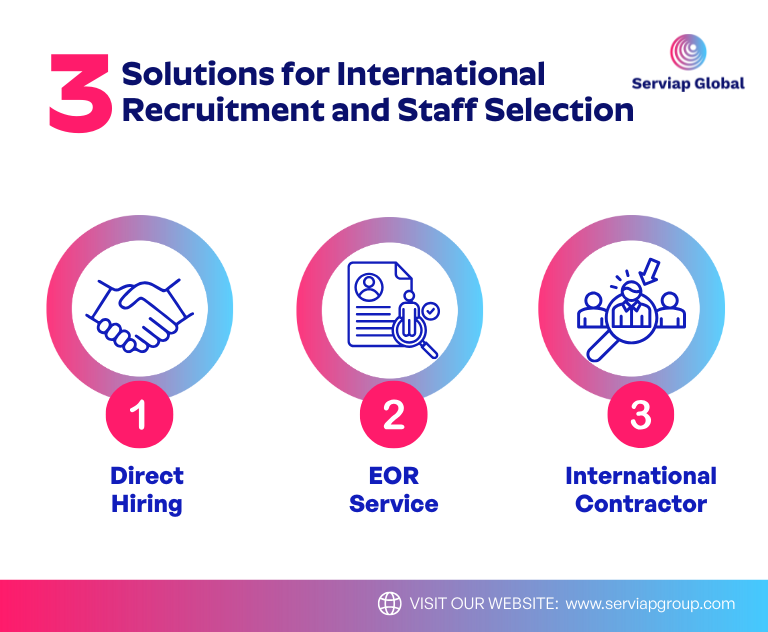
Making the most of the pros and managing the cons carefully will help you make a better decision regarding international recruitment and staff selection options, of which there are three main choices: hiring directly, EOR services, and recruiting independent contractors.

Each of the possibilities, in turn, has benefits and risks, so it is best to design an international expansion strategy carefully, as you also need to think about how your staff will be managed, the tools you need to provide for them, and which channels of communication you want to use with your global team.
Serviap Global helps companies with international recruitment and staff selection solutions in more than 100 countries. Contact us to find out how we can help you.
Key challenges of international recruitment and staff selection
Despite its advantages, international recruitment presents challenges that must be carefully managed.
Time zone differences can complicate collaboration and slow decision-making if workflows and communication processes are not clearly defined. Cultural differences may also affect communication styles, expectations, and team dynamics, requiring cultural awareness and alignment.
Compliance is often the most complex challenge. Employment laws, tax obligations, and worker classification rules vary widely by country. Failing to comply with local regulations or incorrectly classifying workers can result in financial penalties and reputational risk.
Understanding these challenges is essential when selecting the most appropriate international hiring model.
International recruitment models: three main options
There are three primary ways companies approach international recruitment and staff selection. Each model offers different levels of control, flexibility, and risk.
1) Direct hiring
Direct hiring is one of the international recruitment and staff selection solutions for expanding companies. However, it can be a complex process, although possible, as you will need to set up your legal entity in the country of your choice.
This way, you can ensure compliance with all legal obligations, including registering with local authorities and obtaining the necessary permits. Remember that it requires a significant investment of resources and that your entry into a new market will take longer.
Nevertheless, taking responsibility for international recruitment and selection is the best option when you are looking to stay in a country indefinitely and need to employ a significant number of workers.
To hire personnel directly, you must define the entity that best suits your business; these are usually of three types: a foreign representative agency, a branch, or a subsidiary. Your choice will depend on local laws and your expansion needs.
You can hire staff directly, but doing so with the help of a third party will make things easier for you. While you decide which type of entity is the most accurate, an EOR, for example, can source, hire and manage your future employees and assume legal responsibility for the entire international recruitment and staff selection process.
2) Hiring through an Employer of Record (EOR)
If you prefer to have a third party completely take care of your international recruitment and staff selection, which means that you will not have to set up an entity to take part in your operations in another territory, it would be best to rely on an employer of record (EOR).
Also known as an international PEO (professional employer organization) for its co-employment services, an EOR is a third party that sources, hires, and manages employees on behalf of its clients, following local regulations and according to the needs and budget of these companies.

Besides having established entities, the EOR has recruitment networks, knows the local market, and is an expert in local laws, which helps to minimize any legal problems and possible financial penalties.
As part of its services, an EOR handles the paperwork necessary to recruit and select international personnel. It also manages its clients’ human resources, such as payroll, taxes, benefits, and contract termination, all in exchange for a percentage of payroll.
To work with an EOR, first, find the one that suits your needs and jointly establish the type of professionals you require. The EOR will screen profiles, interview the most qualified, present you with a selection of candidates, and, once you choose the next members of your team, make the job offers and sign the necessary contracts.
All personnel you hire through an EOR will report directly to you, so you are responsible for onboarding, assigning, and reviewing tasks and making them feel part of your organization.
3) Hiring international contractors through a Contractor of Record
International recruitment and staff selection can also be supported through contract-based professionals, particularly for project-based, fixed-term, or highly specialized roles. However, managing contractors across borders requires careful attention to compliance and classification rules.
This is where the Contractor of Record (COR) model becomes essential.
A Contractor of Record enables companies to engage independent professionals globally while outsourcing contractor administration and compliance. Contractors remain independent specialists, while the Contractor of Record manages service agreements, payments, and regulatory compliance.
Contractors of Record are typically experienced professionals who work on limited-term projects. They usually provide their own tools and materials, operate with a high level of autonomy, and can work independently or integrate into existing teams.
By working with a Contractor of Record, companies can reduce the risk of contractor misclassification while maintaining flexibility and speed in global hiring.
Comparison table: international hiring models
| Criteria | Direct Hiring | Employer of Record (EOR) | Contractor of Record |
|---|---|---|---|
| Local entity required | Yes | No | No |
| Payroll & administration | Company | EOR | Contractor of Record |
| Compliance responsibility | Company | EOR | Contractor of Record |
| Time to hire | Slow | Fast | Fast |
| Engagement type | Long-term | Long or mid-term | Project-based / fixed-term |
| Scalability | Medium | High | High |
| Best use case | Permanent operations | Market entry and growth | Specialized or short-term projects |
Choosing the right international recruitment model
Selecting the right international recruitment model depends on business objectives, risk tolerance, and growth plans.
Companies expanding into new markets often prioritize speed and compliance, making EOR services a practical solution. Organizations with established international operations may prefer direct hiring for greater control. Contractor of Record services are well suited for companies that need flexibility and specialized expertise without long-term commitments.
Many companies combine multiple hiring models as they scale, adjusting their approach as their global operations mature.
How Serviap supports international recruitment and staff selection
Serviap supports companies throughout the entire international recruitment and staff selection process. As a trusted global partner, Serviap helps organizations design compliant and scalable global hiring strategies aligned with their business goals.
Serviap’s solutions include Employer of Record (EOR) services, Recruitment Process Outsourcing (RPO) for global talent acquisition, Contractor of Record services, contractor management, and immigration and visa support. This integrated approach allows companies to choose the most suitable hiring model while ensuring compliance and operational efficiency.
By combining local expertise with a global reach, Serviap enables companies to build and manage international teams with confidence.
Frequently asked questions (FAQs)
What is international recruitment and staff selection?
International recruitment and staff selection involve sourcing, evaluating, and hiring professionals across borders while aligning talent with business needs and compliance requirements.
What is the safest way to hire internationally?
Working with an Employer of Record (EOR) is often the safest option, as it allows companies to hire employees abroad without establishing a local entity while remaining compliant.
What is the difference between RPO and EOR?
RPO focuses on sourcing and recruiting talent, while an EOR manages employment, payroll, and compliance. Many companies use both services together.
What is the difference between independent contractors and Contractor of Record services?
Independent contractors are engaged directly by companies, which may create compliance risks. A Contractor of Record manages contracts, payments, and compliance, reducing misclassification risk.
Can companies combine different international hiring models?
Yes. Many organizations use a mix of direct hires, EOR employees, and contractors depending on their growth stage and operational needs.