



Table of Contents
Chile enters 2026 with important labor law updates that directly affect employers operating in the country. The confirmed chile labor law changes focus primarily on two key areas: the statutory reduction of the workweek under the “40-Horas” reform and the final stage of the national minimum wage increase.
These updates impact payroll structures, workforce scheduling, employment contracts, and overall labor cost planning. Global employers, foreign companies hiring in Chile, and HR and payroll teams must ensure their systems and policies reflect the new legal framework.
Why 2026 Is a Key Year for Employers in Chile
The chile labor law changes in 2026 are part of reforms approved in prior years but reaching critical milestones now.
2026 is significant because:
- The second phase of the workweek reduction takes effect.
- The final scheduled minimum wage increase under the 2023–2026 agreement becomes mandatory.
- Employers must adjust operational models without reducing pay.
These reforms are not new laws enacted in 2026, but phased implementations of previously approved legislation now entering a new stage.
Key impacted areas include:
- Working hours and scheduling
- Overtime calculations
- Minimum wage compliance
- Payroll cost planning
Working Hours: Reduction to 42 Hours per Week
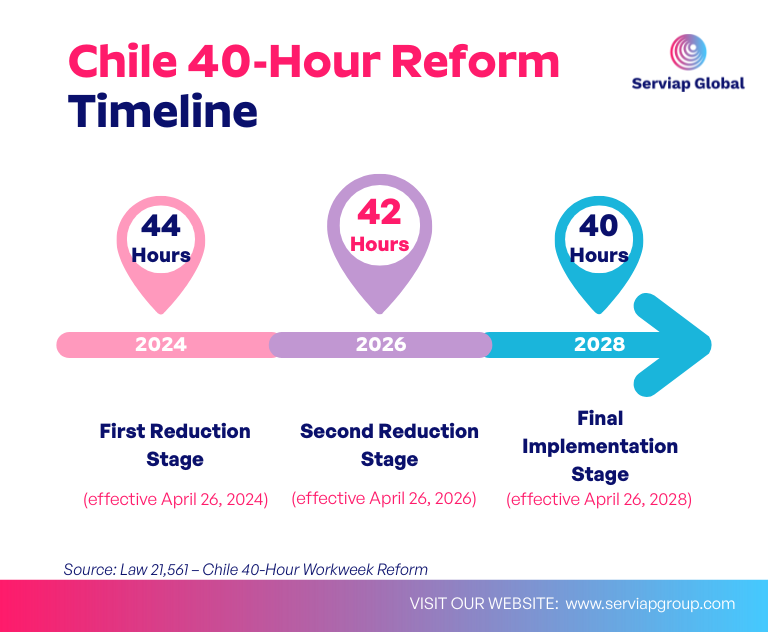
Chile’s Law 21,561 (“40-Horas”) continues its phased implementation in 2026
What changes in 2026
As of April 26, 2026, the maximum ordinary workweek is reduced to:
- 42 hours per week (down from 44 hours)
- Distribution allowed across 5 or 6 days
- Overtime applies to hours exceeding 42 per week
This is the second milestone toward the final 40-hour workweek scheduled for 2028
Employer impact
- Work schedules must be adjusted by April 26, 2026.
- No salary reduction is permitted due to shorter weekly hours.
- Overtime thresholds automatically shift to the new 42-hour cap.
- Employers may need workforce restructuring or additional hires to maintain productivity.
- Updated employment contracts or shift rosters may be required.
Chile Minimum Wage Increase
Chile completes its scheduled multi-year minimum wage increase in 2026
What changes in 2026
Effective January 1, 2026, the national monthly minimum wage is:
- CLP 539,000 per month
- For workers under 18 or over 65: CLP 404,250
This follows the mid-2025 increase to CLP 529,000 and represents the final step of the 2023–2026 wage agreement
What this means for employers
The minimum wage increase affects:
- Base salary obligations
- Overtime calculations (as premiums apply over base wage)
- Wage-indexed fines and benefits
- Payroll budgets, particularly for SMEs
Employers must ensure January 2026 payroll reflects CLP 539,000 as the minimum legal salary.
If you’re hiring in Chile without a local entity, compliance risks increase significantly.
Collective Agreements and Workweek Flexibility
The 40-hour law enables greater flexibility in work schedule distribution
What changes in 2026
- Employers and employees may adopt alternative workweek structures.
- Distribution flexibility allows averaging hours within legal limits.
- Written agreements or collective bargaining may be required.
Employer impact
- Opportunity to implement flexible work models.
- Requires careful documentation and compliance monitoring.
- Internal policies must align with new legal scheduling rules.
Key Compliance Actions for Employers in 2026
To remain compliant with chile labor law changes, employers should:
- Review and update employment contracts before April 2026.
- Adjust payroll systems for the CLP 539,000 minimum wage.
- Recalculate overtime thresholds based on the 42-hour limit.
- Assess workforce capacity and productivity planning.
- Update internal policies and employee handbooks.
- Monitor official guidance from Chilean labor authorities.
For companies without a local entity in Chile, managing these updates internally can be complex. Working with an Employer of Record (EOR) can help ensure compliance with local labor laws while handling payroll and statutory obligations.
Hiring or Employing in Chile in 2026?
Chile’s 2026 labor updates affect:
- Workforce planning
- Overtime costs
- Employment contracts
- Payroll compliance
For foreign companies, managing these obligations without local expertise can create legal and financial exposure.
At Serviap Global, we help companies hire and manage talent in Chile through our Employer of Record (EOR) solutions — ensuring:
- Full compliance with Chilean labor law
- Accurate payroll processing
- Statutory contribution management
- Ongoing regulatory monitoring
Learn how Serviap can help you hire in Chile without opening a local entity.
FAQs about Chile Labor Law Changes in 2026
1. What are the main Chile labor law changes in 2026?
The main changes are the reduction of the workweek to 42 hours from April 26, 2026, and the increase of the monthly minimum wage to CLP 539,000 effective January 1, 2026
2. When does the 42-hour workweek take effect?
The 42-hour weekly limit becomes mandatory on April 26, 2026
3. What is the minimum wage in Chile in 2026?
The minimum monthly wage is CLP 539,000 starting January 1, 2026. Workers under 18 or over 65 receive CLP 404,250.
4. Can employers reduce salaries when hours are reduced?
No. The reduction in weekly hours does not allow salary reductions under the 40-hour law framework.
5. Are there new termination rules in 2026?
No new termination or severance rules take effect in 2026 according to the confirmed official sources.
6. Is the minimum wage increase automatic after 2026?
The CLP 539,000 increase completes the scheduled agreement. No further automatic increases are confirmed beyond this stage.