



Table of Contents
Artificial intelligence is no longer a future concept, it is already reshaping how work gets done across industries. From automation and data analysis to content creation and decision support, AI tools are becoming part of everyday workflows.
Yet while most organizations recognize AI’s importance, many still struggle with a critical challenge: how to prepare their people for this transformation.
AI upskilling is not just about learning new tools. It is about helping teams adapt, build confidence, and integrate AI into the way they work — especially in global and remote environments.
This article explores what AI upskilling really means, why so many initiatives fail, and how companies can approach it in a practical, sustainable way.
Why AI Upskilling Has Become a Business Priority
Across global markets, AI adoption is accelerating. Many companies are already using AI in at least one business function, but usage alone does not equal readiness.
A common issue is the perception gap:
- Employees understand AI is transforming industries
- But often underestimate how much it will affect their own roles
This leads to delayed learning, resistance, or superficial adoption.
For employers, the risk is clear:
- Skills gaps grow faster than hiring pipelines
- Productivity gains remain unrealized
- Employees feel uncertain or disengaged
AI upskilling helps close this gap by turning awareness into capability.
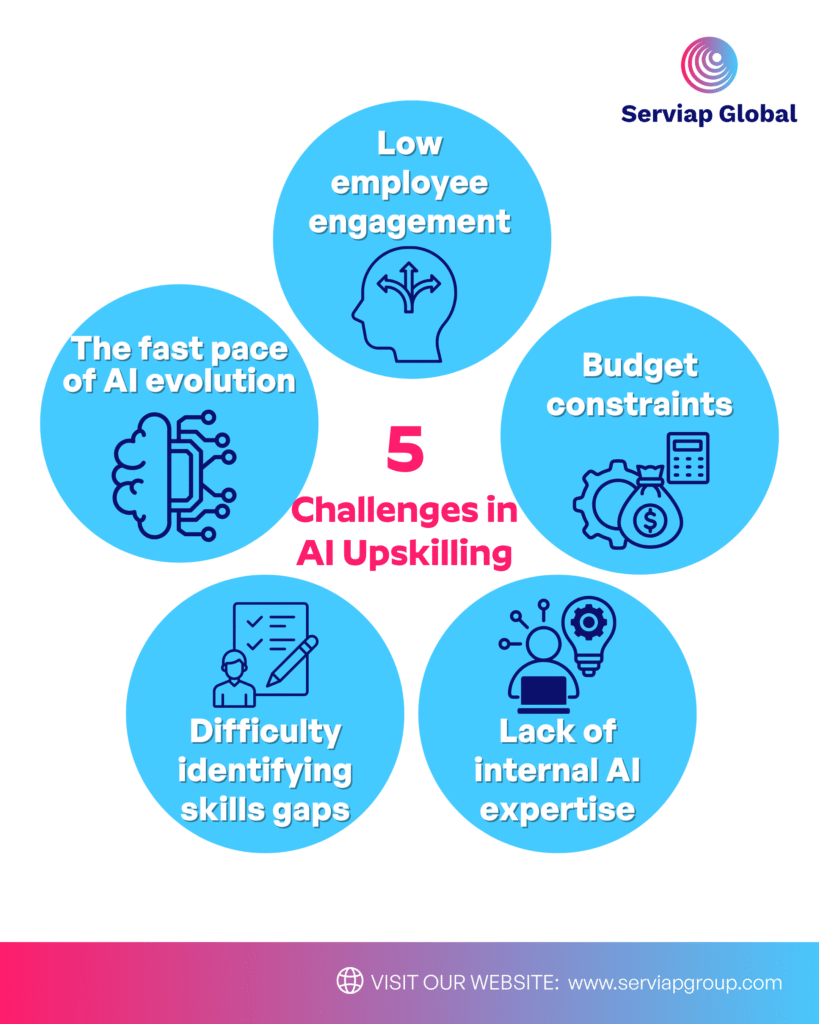
The Most Common Challenges in AI Upskilling
Despite strong interest in AI learning, organizations often face similar obstacles when trying to upskill their workforce.
1. Low employee engagement
One-size-fits-all AI training rarely works. A marketing team, an HR team, and a finance team interact with AI in very different ways. When training feels disconnected from daily work, engagement drops quickly.
2. Budget constraints
Large-scale transformation programs can be expensive. Many companies delay upskilling because they assume it requires major upfront investment, rather than continuous and incremental learning.
3. Lack of internal AI expertise
Not every organization has AI specialists or trainers in-house. This can slow down initiatives or create dependency on external consultants.
4. Difficulty identifying skills gaps
Leaders often struggle to define which AI skills actually matter for their teams. Without clarity, training efforts become scattered or ineffective.
5. The fast pace of AI evolution
AI tools and use cases evolve quickly. Static training programs become outdated almost as soon as they launch.
AI Upskilling Is Not Just Training, It’s Change Management
One of the biggest mistakes companies make is treating AI upskilling as a training rollout instead of a change journey.
Successful organizations approach AI upskilling across three connected dimensions:
1. AI literacy (the foundation)
This includes basic understanding for all employees:
- What AI can and cannot do
- Common AI tools and terminology
- Data privacy, ethics, and risk awareness
- How to evaluate AI output critically
AI literacy reduces fear and builds confidence, especially in early adoption stages.
2. AI adoption (embedding into work)
This is where most initiatives stall. Adoption requires:
- Redesigning workflows to include AI
- Encouraging experimentation
- Aligning incentives and performance metrics
- Supporting learning directly in the flow of work
Without this step, AI remains a “nice to have” instead of a real productivity driver.
3. AI domain transformation (advanced use)
At this stage, organizations:
- Develop role-specific and function-specific AI use cases
- Enable advanced skills like automation, prompt engineering, or AI governance
- Use AI to redesign how work gets done, not just to speed it up
This is where AI becomes a competitive advantage.
Technical Skills Alone Are Not Enough
Many AI learning programs focus heavily on technical skills and those are important. But research consistently shows that soft skills become even more critical in an AI-enabled workplace.
Key human skills that must be developed alongside AI fluency include:
- Critical thinking
- Communication
- Problem-solving
- Collaboration
- Ethical judgment
As AI takes over repetitive tasks, human skills define how effectively teams interpret, apply, and act on AI insights.
What an Effective AI Upskilling Strategy Looks Like
AI upskilling does not need to be complex, but it must be intentional.
Effective strategies tend to share these characteristics:
Learning is relevant and role-based
Training is tailored by function and tied to real use cases employees encounter daily.
Learning is continuous
Short modules, learning sprints, and microlearning work better than one-off programs.
Leaders actively participate
When leaders use AI openly and model learning behavior, adoption increases across teams.
Psychological safety is encouraged
Employees need space to experiment, fail, and learn without fear of consequences.
Skills development is linked to growth
When employees see how AI skills connect to career progression, engagement rises significantly.
AI Upskilling in Global and Remote Teams
For companies managing distributed teams, AI upskilling becomes even more important.
Global teams benefit from:
- Standardized AI literacy across regions
- Consistent policies for AI use and compliance
- Shared tools that support collaboration across time zones
- Clear frameworks for responsible AI adoption
A well-designed upskilling approach helps ensure that all employees — regardless of location — are equipped to work effectively in an AI-enabled environment.
Final Thoughts: From Awareness to Readiness
AI is not replacing people — but it is changing how people work.
Organizations that succeed with AI upskilling understand that:
- Training alone is not enough
- Adoption requires leadership, culture, and systems to evolve
- AI readiness is built over time, not overnight
By investing in continuous learning, aligning skills with real business needs, and supporting teams through change, companies can turn AI from a source of uncertainty into a long-term advantage.
About Serviap Global
At Serviap Global, we help companies build and manage global teams by handling employment, compliance, and workforce operations across Latin America and beyond.
From Employer of Record (EOR) and independent contractor solutions to payroll and workforce compliance, we support organizations as they scale internationally — so teams can focus on growth while staying compliant.
Learn more about how we support global teams
FAQs
What is AI upskilling?
AI upskilling refers to helping employees develop the knowledge, skills, and confidence needed to work effectively with artificial intelligence tools in their daily roles.
Why is AI upskilling important for companies?
Without upskilling, AI adoption remains limited, skills gaps grow, and organizations fail to capture productivity and innovation benefits.
Is AI upskilling only for technical roles?
No. While advanced roles may require deeper technical skills, basic AI literacy is increasingly important for employees across all functions.
How long does AI upskilling take?
AI upskilling is an ongoing process. Continuous learning models are more effective than one-time training programs.
How does AI upskilling support global teams?
It creates consistent capabilities, improves collaboration, and ensures responsible AI use across regions and jurisdictions.