



Table of Contents
Expanding into international markets offers access to new customers, diversified revenue streams, and global talent. But the path isn’t simple. Entering new countries requires navigating complex labor laws, tax structures, cultural dynamics, and operational risks that can slow down, or even derail, expansion if not handled correctly.
Whether you’re exploring opportunities in Latin America, testing a new market before establishing an entity, or hiring remote talent abroad, understanding the main challenges of international expansion is essential for long-term success. Below are the five key challenges companies face today and how to overcome them for optimal performance.

1) New markets: validating demand and choosing the right entry strategy
Understanding a new market requires more than identifying demand. It involves analyzing economic conditions, consumer behavior, regulations, competition, and cultural expectations.
Many global expansion failures come from inadequate market research, unrealistic assumptions, or replicating a home-country business model without local adaptation. Companies must also consider the risks of permanent establishment (PE), which may occur when certain activities unintentionally create taxable presence in another country.
How to overcome this challenge
- Conduct deep, region-specific research on demand, workforce availability, regulations, and operational costs.
- Evaluate economic trends, digital infrastructure, purchasing power, and political stability.
- Test markets before investing fully, such as hiring through an EOR to validate growth potential.
- Adapt product, pricing, and messaging strategies to local expectations.
- Use local advisors to identify regulatory constraints, hidden barriers, and competitive dynamics.
A structured research plan helps companies make informed decisions and avoids the most common global expansion mistakes.
2) Recruitment: acquiring talent compliantly and competitively
Talent acquisition becomes more complex across borders. Different countries have unique employment laws, mandatory benefits, termination rules, and worker classification criteria.
Misclassifying independent contractors, one of the most frequent global expansion mistakes, can lead to fines, back wages, interest, and legal disputes.
Meanwhile, competition for skilled workers worldwide is growing. The International Labour Organization reports that the global share of individuals wanting work but unable to find it has fallen significantly over the past two decades, increasing competition for top talent.
How to overcome this challenge
- Define the roles and skills needed and evaluate talent availability in each target country.
- Localize job descriptions, benefits, and compensation packages.
- Use compliant hiring models:
- Independent contractors, only when permitted and properly classified.
- Employer of Record (EOR) hiring to avoid entity setup, misclassification risk, and compliance issues.
- Establish clear internal processes for onboarding, performance management, and global workforce planning.
- Provide strong cross-cultural training and career development opportunities to improve retention.
Partnering with an EOR allows companies to hire internationally in days, not months, while ensuring compliance with local labor laws.
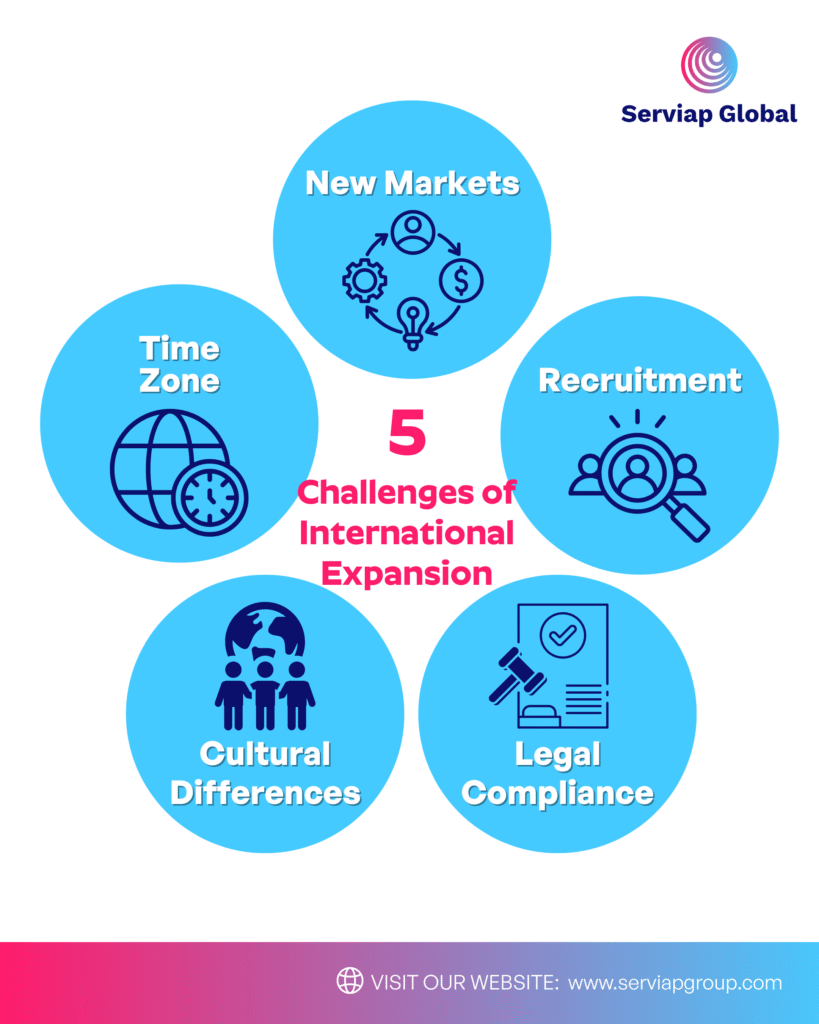
3) Legal compliance: navigating tax, labor, and regulatory complexity
Compliance is one of the most difficult aspects of global expansion. Every country has different rules governing employment, payroll, tax contributions, social security, termination, and benefits.
Businesses expanding internationally may face risks such as:
- Tax exposure due to PE rules
- Incorrect payroll filings
- Non-compliance with mandatory benefits
- Contract errors
- Local termination rules being overlooked
- Wrong worker classification
- Unexpected tax reporting obligations
Failing to comply can trigger audits, penalties, and reputational damage.
How to overcome this challenge
- Use localized employment contracts and country-specific HR policies.
- Document hiring, onboarding, payroll, and termination procedures for each location.
- Monitor regulatory changes regularly , labor codes, social contributions, VAT requirements, and tax treaties change frequently.
- Work with in-country specialists to avoid hidden compliance risks.
- Use an EOR to ensure compliance with mandatory payroll cycles, tax filings, statutory benefits, and labor laws.
Building compliance into the expansion strategy from the start prevents costly consequences later.
4) Cultural differences: aligning communication, expectations, and workplace norms
Cultural dynamics shape how teams communicate, give feedback, negotiate, and collaborate. Misunderstandings can lead to low engagement, poor morale, or hiring mistakes. What motivates employees in one country may not resonate in another.
Additionally, workplace expectations, such as hierarchy, work-life balance, communication style, benefits preferences, or holiday schedules , vary significantly across regions.
How to overcome this challenge
- Train managers on international communication styles and cultural sensitivity.
- Adapt HR policies where needed (holiday calendars, working hours, leave policies).
- Encourage feedback from local employees to understand cultural expectations.
- Build mixed teams that include regional experts with local insights.
- Use collaboration tools that support multilingual communication and accessibility.
Understanding culture strengthens internal alignment and improves local market engagement.
5) Time zones: balancing real-time collaboration with operational efficiency
Managing global teams often means dealing with time zone differences that complicate communication, project timelines, and meeting schedules.
Companies that offshore or work across distant regions operate asynchronously, which can slow decision-making. Others choose nearshoring to reduce time zone gaps and improve collaboration.
How to overcome this challenge
- Establish clear guidelines for response times, meeting windows, and communication channels.
- Use asynchronous tools (recorded video updates, shared workspaces, project management platforms).
- Consider nearshoring when real-time collaboration is essential.
- Rotate meeting schedules to avoid placing the burden on one region.
- When managed well, global time zones offer advantages such as 24/7 productivity.
Serviap Global helps companies overcome the challenges of international expansion
Serviap Global supports organizations expanding into new markets by managing the complexities of hiring, compliance, payroll, and onboarding; without the need to establish legal entities.
Through our international Employer of Record (EOR) and global talent acquisition services, you can:
- Hire employees in 100+ countries
- Avoid misclassification risks
- Ensure compliance with local labor and tax laws
- Manage payroll, benefits, and contracts seamlessly
- Test markets before investing in subsidiaries
- Build globally distributed teams efficiently and compliantly
We help you expand confidently while focusing on strategic growth.
Schedule a consultation with Serviap Global and discover how our EOR solutions simplify international expansion.
FAQs about international expansion
What is the biggest challenge of international expansion?
The biggest challenge is navigating local compliance, including labor laws, tax requirements, mandatory benefits, and worker classification. Mistakes in these areas can lead to fines and delays.
Do I need a legal entity to hire employees abroad?
Not necessarily. Through an Employer of Record (EOR), companies can hire full-time employees internationally without opening a subsidiary.
How can companies avoid contractor misclassification?
Use country-specific classification criteria, local contracts, and professional guidance. An EOR ensures proper worker classification.
What’s the fastest way to hire employees in a new country?
Hiring through an EOR is the quickest and most compliant option, allowing companies to onboard employees in days.
How do companies handle payroll across multiple countries?
Using an EOR or centralized global payroll platform ensures correct pay cycles, statutory deductions, currency handling, and tax filings.